Finding Comfort When Bedbound: A Community Member Shares Her Advice
August is Severe ME/CFS Awareness Month, a time to recognize and honor the experiences of those living with the most disabling form of myalgic encephalomyelitis/chronic fatigue syndrome (ME/CFS). People with severe ME/CFS often spend most of their days in bed, facing profound limitations that affect every part of daily life.
As part of this awareness month, a community member generously offered to share her personal strategies for making her space more comfortable and manageable while living mostly bedbound. Her advice reflects creativity, trial and error, and a deep understanding of how even small changes can make daily life a little easier.
Bedside Setup: What Helps Me Manage Life Mostly Bedbound
Since becoming mostly bedbound, I’ve found that setting up my nightstand and immediate surroundings makes a big difference in conserving energy and avoiding frustration. Here are some things that help me:
Around the Nightstand
- Clip-on light that can be reached without moving my body, so I can find things in the dark.
- Charging cable holders and a power strip mounted behind the nightstand.
- Rolled towel or pool noodles between furniture and the bed to keep items from falling out of reach.
- AirPods (I keep two sets for noise-canceling and audio), with an around-the-neck holder.
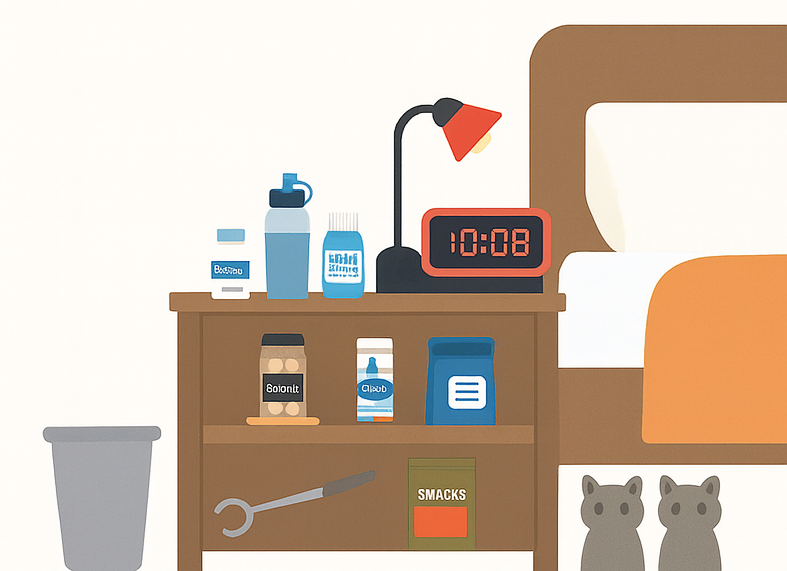
- Small trash can nearby and a short grabber for items that drop.
On or In the Nightstand
- Medications, supplements, coasters, ice packs, heating pad, and a large red digital clock.
- Water bottle with a flip straw, Blistex, eye drops, eyeshades, earplugs, and extra socks.
- Snacks (sealed to minimize food in the bedroom) on the bottom shelf.
Other Helpful Additions
- Mini-fridge just outside the bedroom, stocked with essentials like fruit, Gatorade, and ice packs.
- Room-darkening curtains to reduce sensory overload.
- Pressure point care: lotions, memory foam mattress and pillow, and frequent position changes.
- Sunglasses in each room to avoid carrying them back and forth.
- Easy-clean items like waterproof pillow covers and towels for hair or ice packs.
- A notification system to alert my partner in another room.
Supporting My Body
- Armless reading glasses that allow me to rest on my side.
- Bolsters, quilts, and pillows to support different body positions and reduce discomfort.
- Dictation features on phone and laptop to conserve energy instead of typing.
- And of course, my cats nearby bring comfort too.
Resources Mentioned
This contribution offers a glimpse into the resourcefulness required to live with severe ME/CFS.
By sharing her bedside setup, this community member provides practical, hard-earned wisdom that may help others facing similar challenges. We are deeply grateful for her generosity in opening up her experience and hope her ideas bring comfort and support to those who need it most.
 Lucinda Bateman, MD, is a renowned clinician, researcher, and educator. Her Johns Hopkins University Medical School training instilled an approach to care that she has employed throughout her career – the patient comes first and the unknown or unexplained does not equate to a lack of proper and compassionate care. Since starting her own practice in 2000, she has served on six boards or committees, been the principal investigator for 45 studies, authored/coauthored 40 journal articles, served as adjunct instructor and adjunct assistant professor in the University of Utah Departments of Preventative Medicine, Internal Medicine, and Anesthesiology, and lectured around the world.