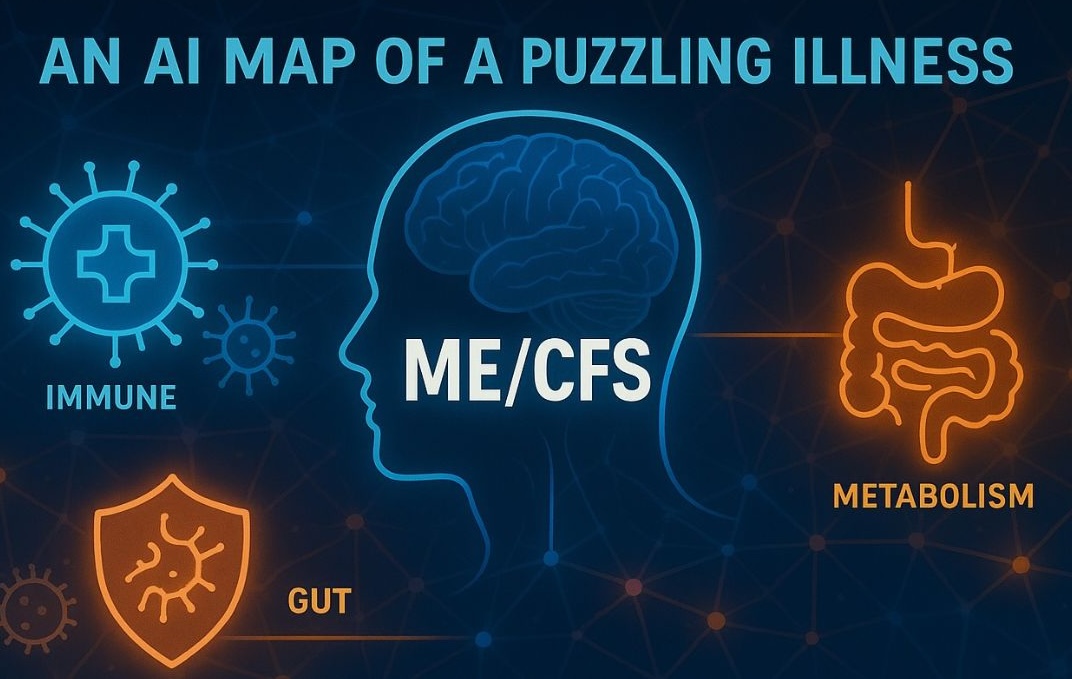
An AI Map of a Puzzling Illness: How BioMapAI Tries to Decode ME/CFS, One Symptom at a Time
Myalgic encephalomyelitis/chronic fatigue syndrome (ME/CFS) is notorious for its complexity: a disabling illness marked by crushing fatigue, post‑exertional malaise, pain, cognitive fog, sleep problems, orthostatic intolerance, and more, often persisting for a lifetime, without a clear biological fingerprint. Despite years of suffering, people with this condition have heard the same refrain: “Your labs are normal.”
A new study in Nature Medicine, with contributions from BHC’s Lucinda Bateman, MD, and Suzanne Vernon, PhD, challenges that narrative. Researchers built BioMapAI, an artificial intelligence model trained on one of the most detailed ME/CFS datasets ever collected, to map how the immune system, gut microbiome, and metabolism interact—and how those systems relate to what patients feel day to day.
Instead of searching for a single “smoking gun,” the study takes a systems approach, revealing that ME/CFS is not one broken part but a network out of balance.
A Four-Year, 249-Person Portrait of ME/CFS
To create this map, researchers followed 249 people for up to four years—153 with ME/CFS and 96 healthy controls. They collected stool samples (to study gut bacteria), blood samples (to look at immune and metabolic changes), and detailed symptom diaries. The sheer depth of the data—more than 1,400 samples—allowed the team to look beyond isolated findings and instead see how the body’s systems talk to each other over time.
The results demonstrated what many people with ME/CFS already know: symptoms don’t progress in neat, linear ways. They rise and fall, sometimes dramatically, in patterns that defy simple explanations. This helps explain why past research, often based on single test results, has struggled to find consistent biomarkers.
How BioMapAI Works
Most machine-learning studies look at a single outcome—such as whether a person is sick or healthy. BioMapAI goes further. It predicts 12 different symptom scores at once, including fatigue, pain, sleep disturbances, and cognitive difficulties. It uses “multi-omics” data—essentially, layers of biological information like gut microbes, immune activity, and chemical signals in the blood—to find which biological changes match which symptoms.
Imagine a multi-dimensional map, where every “road” is a connection between a gut microbe, a chemical in the blood, or an immune cell. BioMapAI looks for traffic patterns—where the roads flow normally in healthy people but are blocked or rerouted in ME/CFS.
What BioMapAI Reveals
- The immune system is central.
Immune signals, particularly those linked to inflammation, were the strongest predictors of symptom severity. Certain immune cells, like MAIT cells and gamma-delta T cells, were overactive and correlated with fatigue and pain. - Gut microbes are out of balance.
People with ME/CFS had fewer “good” bacteria that produce butyrate, a compound that helps reduce inflammation and keep the gut healthy. Without enough butyrate, the immune system can become more reactive. - Metabolism is altered.
The study found changes in amino acids like tryptophan and branched-chain amino acids (BCAAs), which play roles in energy production and brain health. These shifts may contribute to both physical exhaustion and mental fog. - The body’s communication network is disrupted.
In healthy people, the gut, immune system, and metabolism communicate smoothly. In ME/CFS, these connections weaken or even reverse, creating a state where inflammation takes over.
How Well Does the Tool Work?
When BioMapAI used its symptom predictions to classify who had ME/CFS and who didn’t, it reached an accuracy score (AUC) of about 0.91—strong, though not perfect. Even when tested on outside datasets, BioMapAI outperformed most other models, though accuracy dropped slightly, which is common when comparing across different labs and patient groups.
A Broken Conversation Between Gut and Immune System
The study paints a vivid picture of a body whose internal communication systems have gone awry. In healthy individuals, gut bacteria act like microscopic partners, producing beneficial compounds—such as short-chain fatty acids (including butyrate)—that help keep the immune system balanced and energy metabolism running smoothly. Butyrate, for example, not only supports gut health but also acts as a calming signal for immune cells, preventing unnecessary inflammation.
In people with ME/CFS, this delicate balance appears to break down. Helpful microbes like Faecalibacterium prausnitzii, which are known for their anti-inflammatory effects, were found to be depleted. At the same time, inflammatory immune cells—particularly MAIT cells and gamma-delta T cells—step into the spotlight, driving signals that can worsen fatigue, pain, and other hallmark symptoms.
What emerges is a picture of a “conversation” between the gut and immune system that has been disrupted. Instead of a steady back-and-forth of calming signals, inflammatory messages dominate the network. These changes aren’t isolated—they ripple through the body, affecting not only immune function but also metabolism, mood, and even sleep. The researchers found that these shifts lined up closely with the severity of patients’ symptoms, suggesting that this broken conversation may be a key driver of the illness.
Why It Matters and The Big Picture
The findings are correlations, not proof of cause. Still, they offer new hypotheses: disrupted pathways involving tryptophan, BCAAs, and gut bacteria may be reshaping how the immune system behaves and how symptoms appear.
Instead of looking for a single biomarker, BioMapAI emphasizes that ME/CFS is a network disorder—an illness caused by multiple systems falling out of sync. This approach could help researchers develop personalized maps of illness that lead to more precise diagnostics and treatments.
While BioMapAI may not solve ME/CFS, it helps move the field toward a systems-level understanding, acknowledging the illness’s complexity and showing how gut microbes, immune cells, and metabolism work (or fail to work) together.
If future studies validate these findings across larger and more diverse groups, we may finally begin to untangle the biological roots of ME/CFS—and bring hope to patients who’ve waited far too long.
BHC’s Role in Moving Research Forward
BHC played a crucial role in this research. Lucinda Bateman, MD and Suzanne Vernon, PhD, were key authors, shaping the study and ensuring that the patient voice was at the heart of the research.
BHC continues to lead in both patient care and cutting-edge research, bridging the gap between science and the lived experiences of people with ME/CFS. By supporting BHC, you’re helping to fund the type of research that brings us closer to answers, treatments, and a future where patients are no longer left in the dark.
 Lucinda Bateman, MD, is a renowned clinician, researcher, and educator. Her Johns Hopkins University Medical School training instilled an approach to care that she has employed throughout her career – the patient comes first and the unknown or unexplained does not equate to a lack of proper and compassionate care. Since starting her own practice in 2000, she has served on six boards or committees, been the principal investigator for 45 studies, authored/coauthored 40 journal articles, served as adjunct instructor and adjunct assistant professor in the University of Utah Departments of Preventative Medicine, Internal Medicine, and Anesthesiology, and lectured around the world.